
FREEDOM LACE SHARDS
2024 | Winning Competition Entry

In response to the call for ideas for “Appropriating the Palace”, artists, architects and designers from sixteen countries submitted 152 works that show a wide range of content and design ideas for interventions on the Berlin Palace façade. From these, jury members Julia Grosse, Annette Maechtel and Hito Steyerl selected 21 works, which were presented publicly by their authors in the nGbK.
Organiser: Initiative Schlossaneignung
Presentation:
10.10.24, 19:00
nGbK am Alex
Karl-Liebknecht-Str. 11/13, 10178 Berlin
FREIHEIT SPITZE SCHERBEN | Manifest!
Anna Krenz | Sinus 3
Prussian imperialism, which contributed to the partition of Poland in the 19th century, is an aspect of history that should be included in the debate about the Humboldt Forum. However, Poland does not feature in the discussion about colonialism. Colonialism was colonised. It is not only about the imperial powers, but also about the shift in the boundaries of perception and the culture of remembrance. Poland, which once disappeared from the map of Europe due to the partitions by Prussia, Austria and Russia, is once again overshadowed by historical events. In the exhibitions at the Humboldt Forum (with one exception), the subject of Poland is not addressed. Does it have to be? Yes, it should, because you can’t talk about the history of Germany without taking Poland’s history into account.
A race for the historical narrative has begun in Berlin — about who is talked about and how, who is remembered as a victim, who is celebrated as a hero and who is erased from the history books. Who is the victim of Prussian imperialism and German nationalism? Are we only victims, or are we also fighting ‘for our and your freedom’? In the context of Poland, the next anniversaries mark the stages of this race, but the glass ceiling of discrimination and post-colonial practices continues to limit our participation in the debate on the culture of remembrance. A debate that was led for eight years by the right-wing PiS party, which appropriated the culture of remembrance and turned it into nationalism, is now being led by the Bundestag and exclusive academic circles. Should we boycott these discussions or fight for our vote? Being against it is not enough.
The project is a kind of manifesto that deals with German-Polish relations and previously ignored voices. It focuses on the definition of the victim of a regime, but also shows the strength of those who fight against it. Because just being a victim is not enough. The proposed projects aim not only to provoke, but also to stimulate a profound reflection on how the past shapes our present. The history of Poland and Germany is a story of thousands of years of neighbourliness, conflict and mutual influence. For centuries, it was told by men who marginalised the role of women in politics, society and culture. It is time to change this narrative. It’s time for herstories — women’s stories, time to make the female perspective known in the collective consciousness. It is an opportunity to reflect on the legacy of German colonialism and its impact on Poland and other nations that suffered under the oppression of Prussian imperialism and later German nationalism. Especially in the context of contemporary narratives that are ignored by the establishment. Time for sisterhood.
Installation: ‘Freiheit Spitze Scherben’:
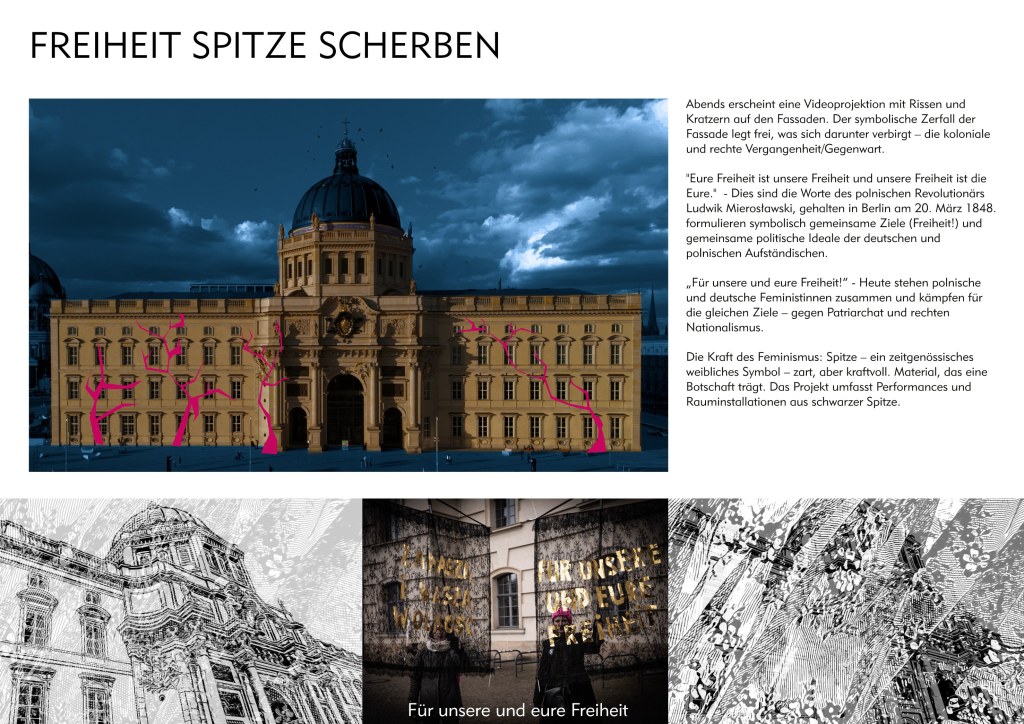
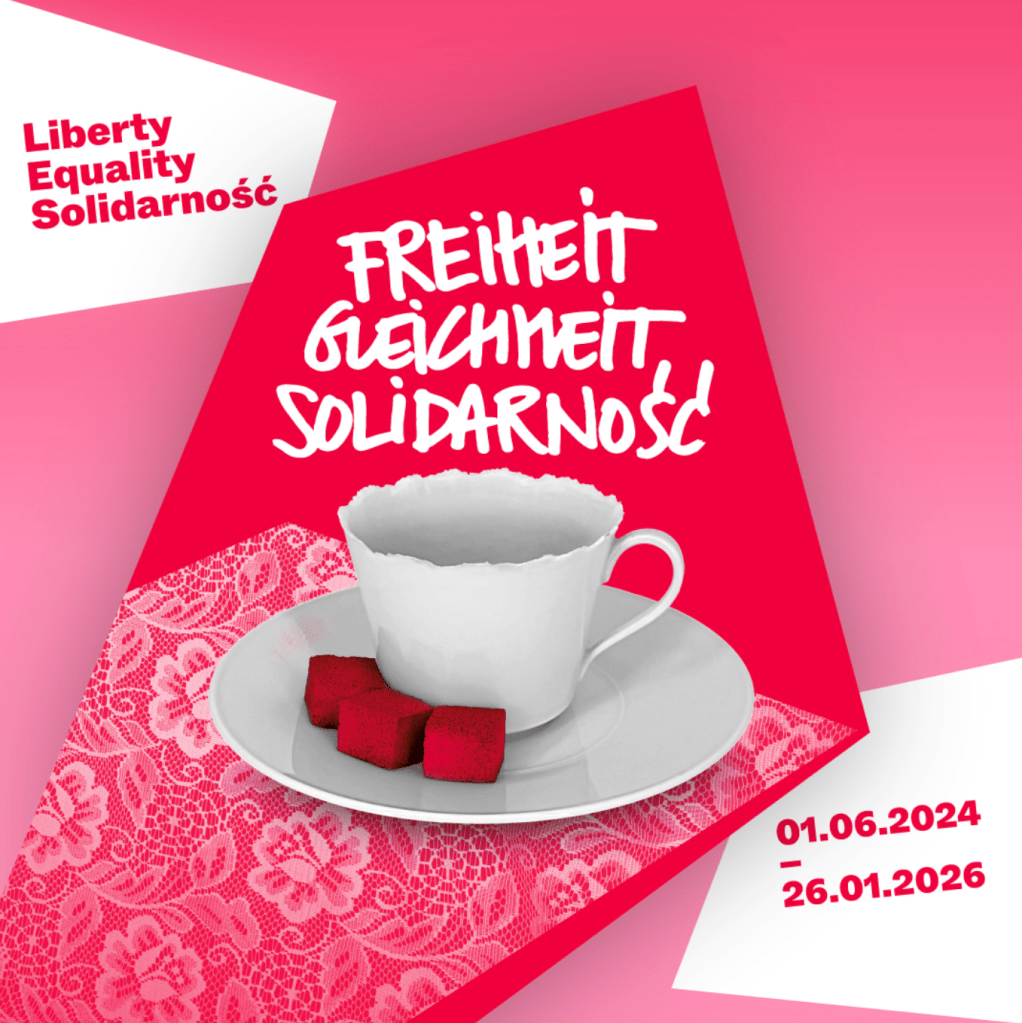
The project is not aimed at a boycott of the Humboldt Forum, but at its symbolic takeover. The starting point is an artistic object — a KPM cup that was on display in the special exhibition „Freiheit, Gleichheit, Solidarität. Polnische Standpunkte in Berlin“ (runs until January 2026) and is part of the BERLIN GLOBAL exhibition. The cup with a broken rim and three red sugar pieces reflects loss and destruction, but also the ambivalent German-Polish relations — bittersweet, full of wounds, but also moments of sweet cooperation.
Shards: The space around the building is to be covered with sculptures or real porcelain shards. Through the motif of ‘shards’ — fractures and destruction — the façade is intended to express painful memories, reveal hidden history and offer space for reflection. The Humboldt Forum is falling apart and showing its nakedness.
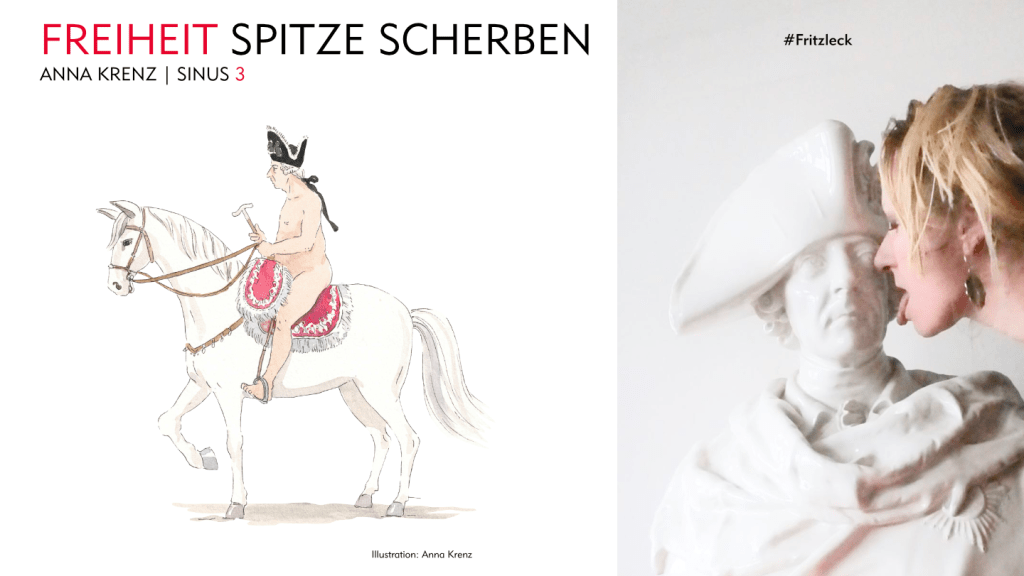
Projection: In the evening, the façade is to be illuminated in such a way that the cracks and shards are emphasised by dynamic light — in some moments it should give the impression that the façade is being ‘repaired’, in others that it is breaking again. The cracks are the beginning of the break, the prelude to the shards of history that must be shown and then reassembled — perhaps in a new form. The creative power makes it possible to create new qualities and to shape reality the way we want it to be. The king should be stripped of his clothes.
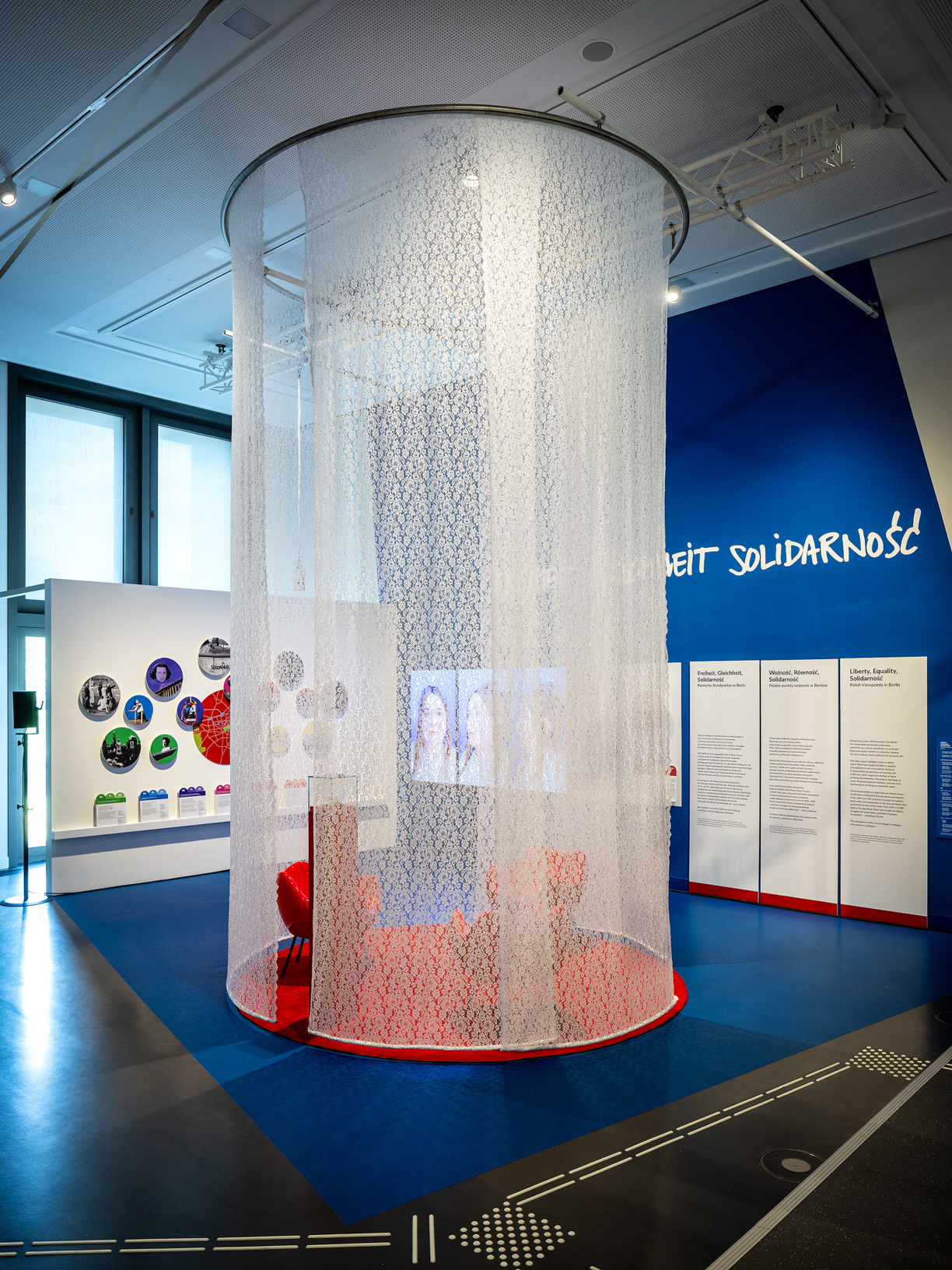
Lace: is not only an aesthetic material, but also a symbol of intimacy, protection, change of perspective and a political manifesto with a feminist message. An installation made of lace fabrics is proposed to create a safe space (free of imperialism and nationalism) and at the same time to form a contrast to the concrete building of the city palace. The king is naked. And we are free.
With photos from: Maciej Soja / Soja Photography, Mareike Wenzel
More details about Initiative Schlossaneignung and the project: >>>
More – taz.blog in German >>>
A publication by DOM Publishers with the 21 selected works and several texts on the topic is published (free online pdf) dom-publishers.com/products/schlossaneignung >>>


Liberty, Equality, Solidarność.
2024 | Exhibition
Exhibition
Location
Berlin Exhibition at the Humboldt Forum
Schloßplatz
10178 Berlin
Opening hours
Mo + Mi – So | 10:30 – 18:30 Uhr
Di | closed
Date:
01.06.2024 – 26.01.2026, Berlin
Liberty, Equality, Solidarność. Polish Viewpoints in Berlin.
Open Space | Berlin Exhibition at the Humboldt Forum
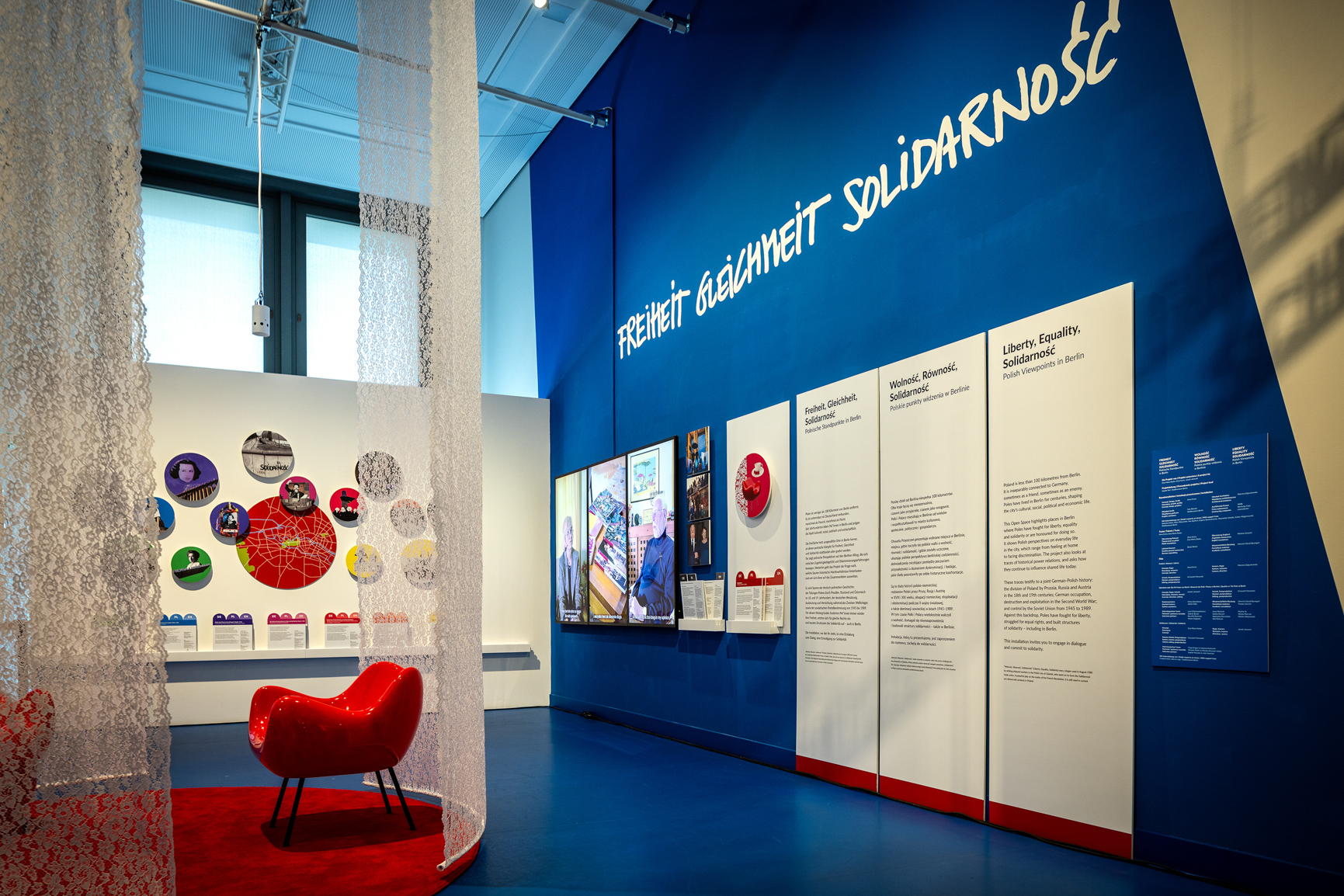
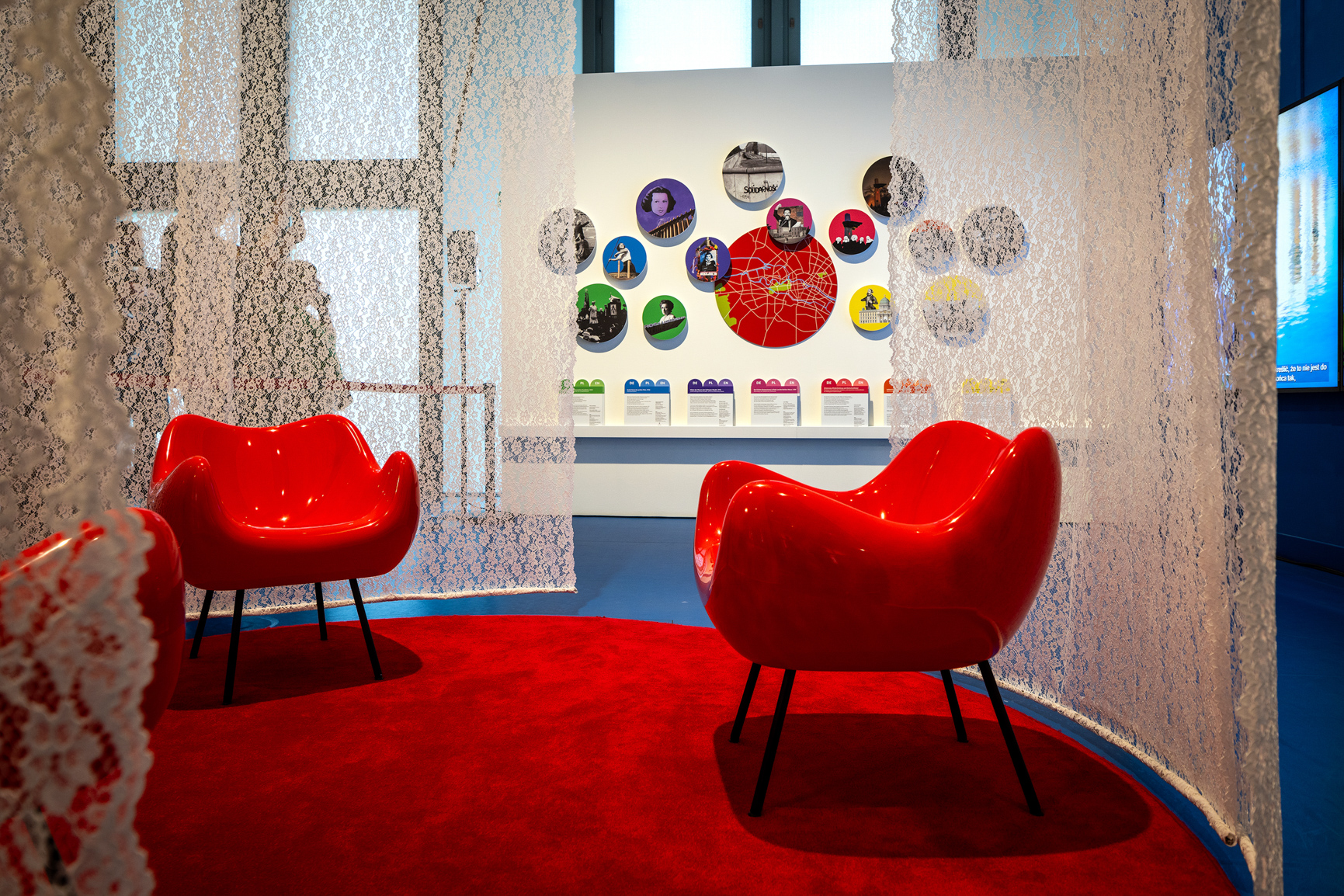
The Open Space “Liberty, Equality, Solidarność” in the BERLIN GLOBAL exhibition looks at Berlin as a site of Polish struggles for freedom and against discrimination, as well as a place of dialogue and solidarity.
Poles have lived in Berlin for centuries and shaped the cultural, social, political and economic life of the city. The Polish border is less than 100 kilometres away. And yet, the city’s close ties with its neighbouring country sometimes only become visible at a second glance.
The multi-layered installation by Ewa Maria Slaska, Anna Krenz and Jemek Jemowit introduces visitors to seven sites in Berlin where Polish people have fought for freedom, equality and solidarity. Spread throughout the city, they include the Olympic Stadium, the Warschauer Brücke, Moabit Prison and Volkspark Friedrichshain. The Open Space also shares Polish perspectives on everyday life in Berlin, moving between a sense of belonging and experiences of discrimination. It explores the traces of historical power relations and the ways they affect coexistence.
The Open Space invites visitors to share their different points of view and engage in dialogue, even when the topics are difficult. In doing so, the Open Space itself becomes a further place of Polish-Berlin solidarity.
Poland’s history is characterised by partitions by Prussia, Russia and Austria in the 18th and 19th centuries, by German exploitation and extermination during the Second World War and by Soviet foreign influence from 1945 to 1989. Against this backdrop, Poles repeatedly fought for their freedom, campaigned for equal rights and built structures of solidarity – including in Berlin.
A project by Anna Krenz, Ewa Maria Slaska, Jemek Jemowit.
Concept, architecture, design, graphics: Anna Krenz
Architectural assistance: Marzena Zajączkowska
Texts: Anna Krenz and others
Video section: „Freiheit | Wolność | Liberty”
Concept, direction: Anna Krenz
Camera, direction: Marzena Zajączkowska
Postproduction: Krzysztof Honowski
More details on Stadt Museum Website >>>
Photos: The Open Space “Liberty, Equality, Solidarność” in the BERLIN GLOBAL exhibition © Ewa Maria Slaska, Anna Krenz, Jemek Jemowit | Stadtmuseum Berlin, photo Michael Setzpfandt


Missing Part of History
2022 | HERstory Project
Event:
Exhibition, discussions, concerts and performances – cooperation
Date:
September 2022, Berlin
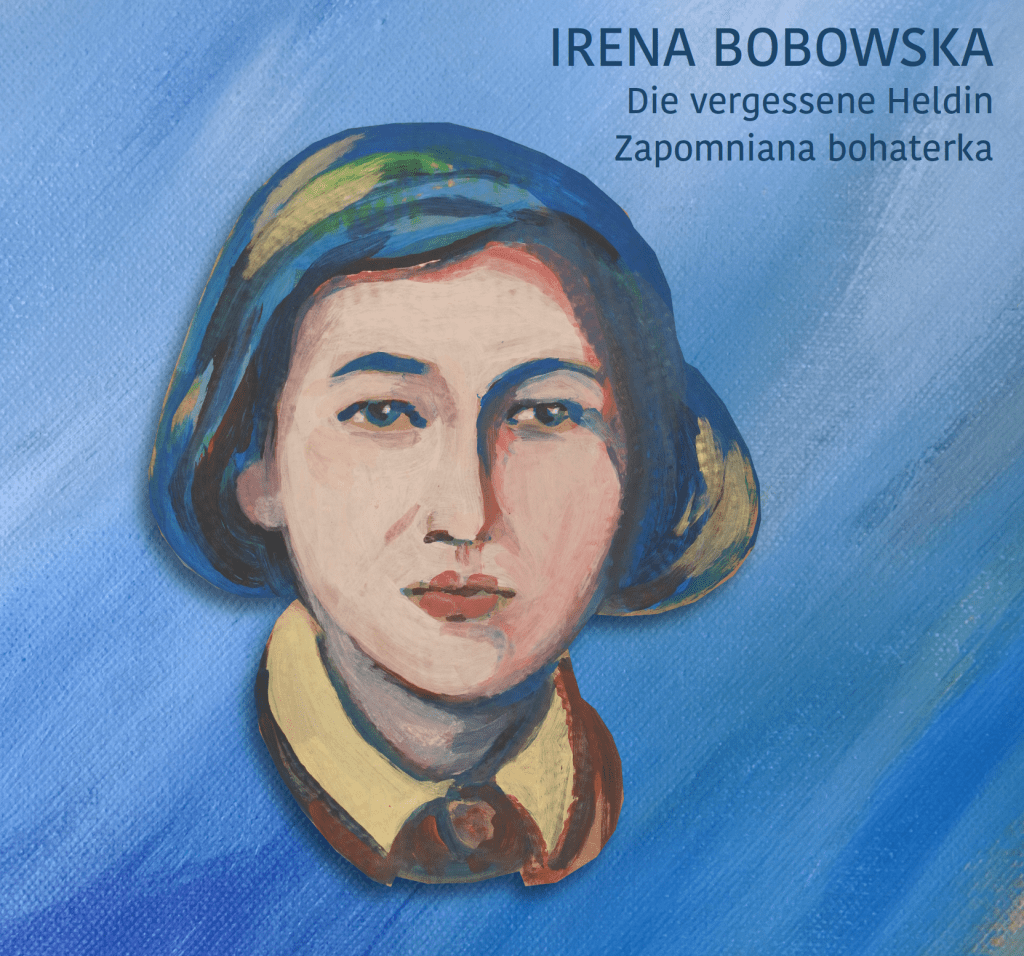
Missing part of history. Irena Bobowska, the forgotten heroine.
The “Missing Part of History” project is an attempt to supplement Polish-German history by reminding Polish women who fought for freedom during World War II. The project is another contribution to the debate about history in relation to the present, especially in the face of another war in Europe.
Who were these women, Polish women who fought for freedom? How much can we learn from history and how can we talk about it? How can we preserve the memory of forgotten heroines?
In recent years, there has been a discussion in Berlin about memorial sites and the possible location of the monument to the Polish victims of National Socialism. The debate was long, it took place among people at various high levels and scientific positions, among politicians, in the Bundestag. Women, especially young women, representatives of civil society, or those not belonging to closed scientific circles and interested persons, did not participate.
The protagonist of the project is Irena Bobowska, a poet from Poznań, who was murdered by the Nazis in Berlin at the age of 22. For us, she is a symbol of all those young, talented women who were murdered, destroyed, tortured during the war, and then banished into oblivion by posterity.
The project consisted of four events with performative readings of Bobowska’s poems, discussions with invited experts, concerts and an exhibition about the life of Irena Bobowska. In the accompanying commemorative newspaper Pobudka, Bobowska’s poems in Polish and German were presented – each poem translated by a different woman.
The events took place in four different locations and were accompanied by the Embassy of Polish Women, an art project by Anna Krenz. The Embassy of Polish Women is a temporary mobile spatial installation with lacy walls; it hosts meetings, exhibitions and discussions on politics, the environment and engaged art. The opening and inauguration of the Embassy took place in June 2020 at the Haus der Statistik in Berlin.
How can common historical debates and art contribute to a deeper understanding and avoid repeating history?
Project by Dziewuchy Berlin, Cooperation: Sinus 3, Botschaft der Polinnen, Ambasada Polek e.V., International Council of Polish Women+
Project supported by the Berliner Senatsverwaltung für Kultur und Europa;
Event in Volkspark Friedrichshain supported by the Bundesministerium für Familie, Senioren, Frauen und Jugend im Rahmen des Bundesprograms Demokratie Leben!
Research supported by: The Foundation for Arts Initiatives https://ffaiarts.net
Photos: Ela Kargol, Maciej Soja / Soja Photography


ZEROREZERO
2003 | Performance & Exhibition

Event:
Opening of the Gallery ZERO,
Köpenicker Str. 4, 10997 Berlin
(Closed 2012)
Date:
10.5.2003
ZEROREZERO
PROGRAM:
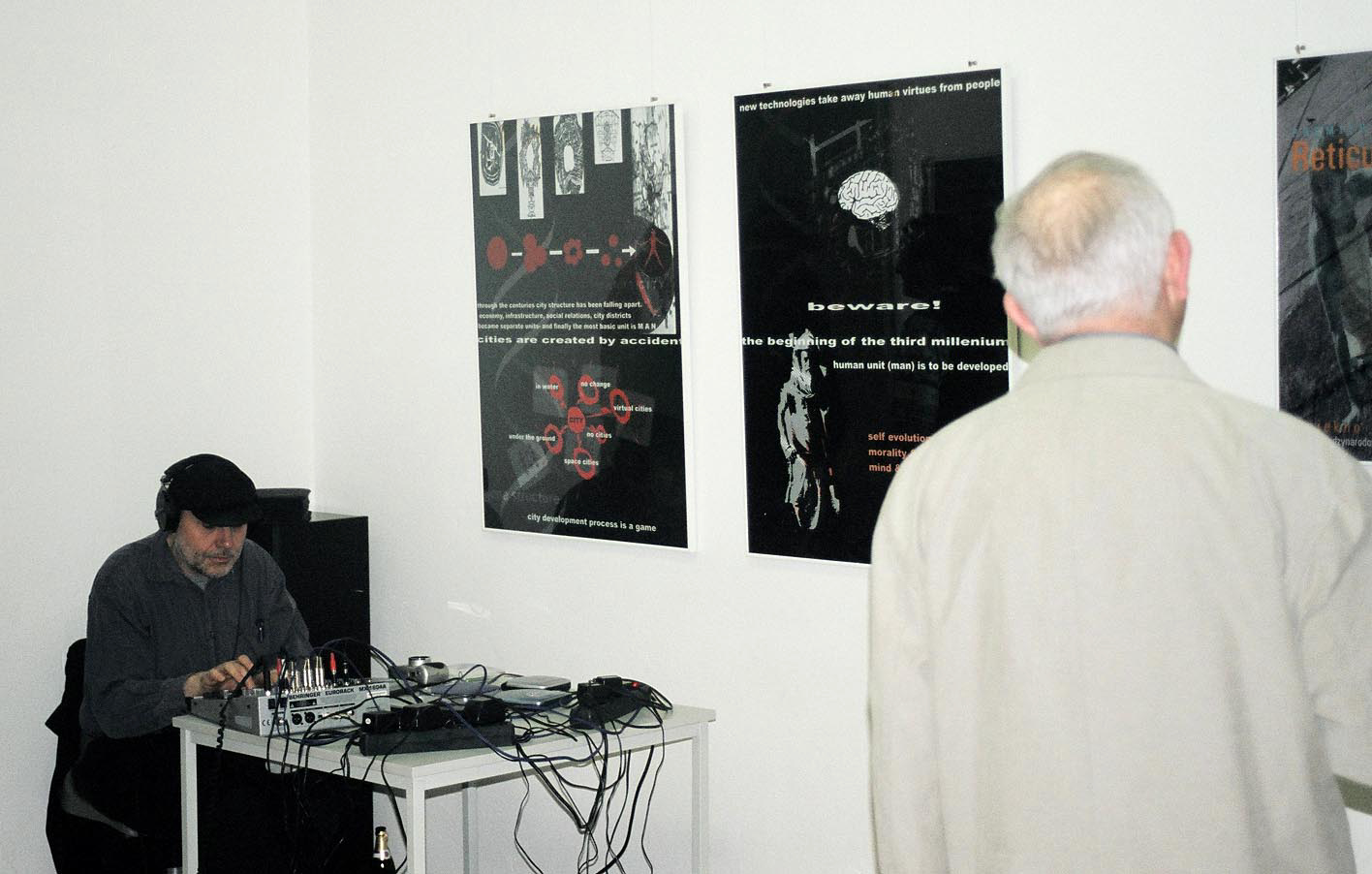
Conrad Schnitzler’s „Cassette Concerts” presented by Wolfgang Seidel
In the 70s Conrad Schnitzler built the „Cassette Organ” two cases with a total of 12 cassette recorders to present his sound collection and his compositions as a live collage. The performance concept is now presented with CD players instead of the cassette recorders by Wolfgang Seidel.
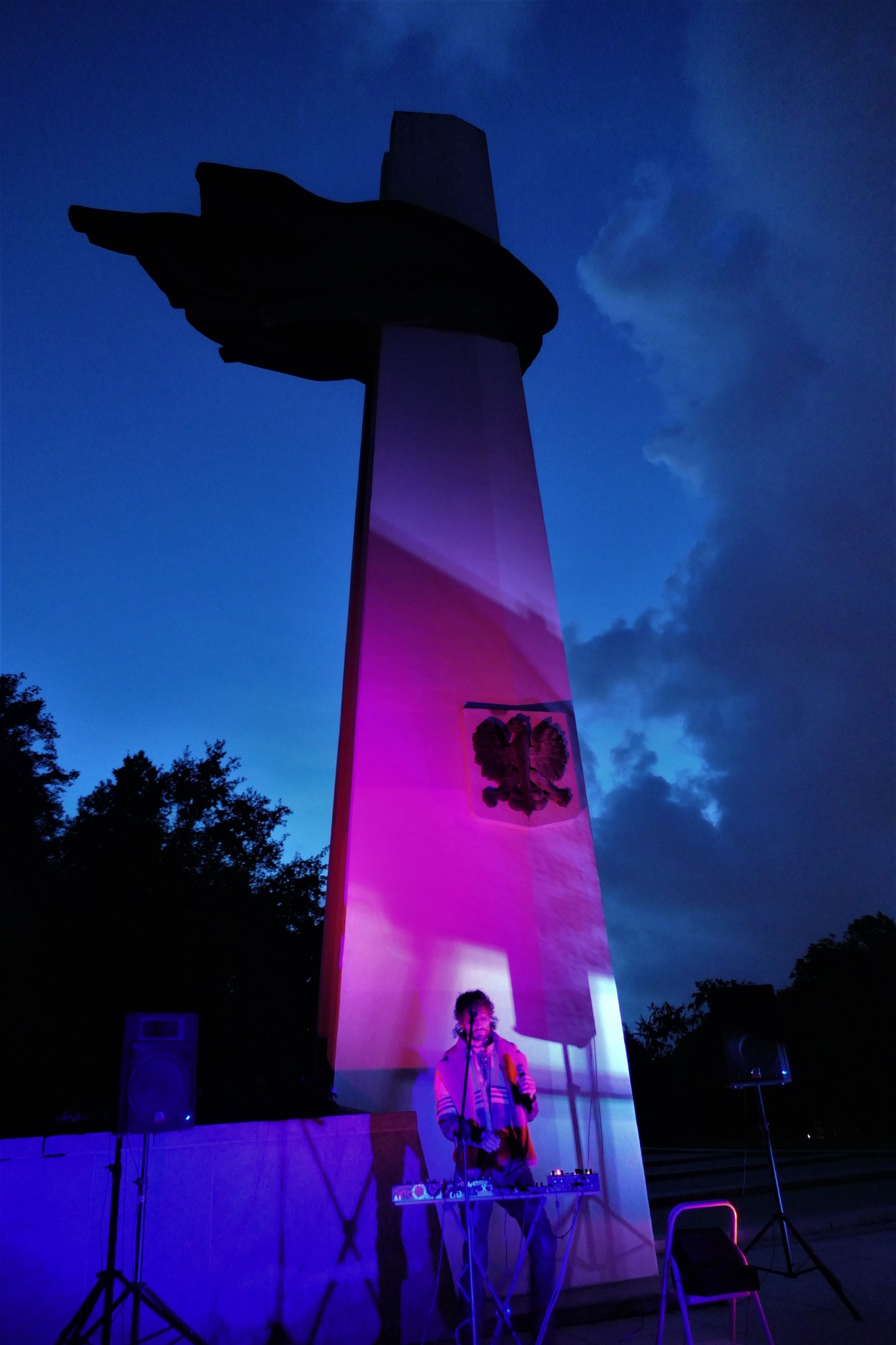
Happening of Sinus_3 (Poznań/ Poland)
The work of the group is presented in an exhibition. The happening „zerorezero” is conceived as a reflection of the place.
Happening of Centrala Rybna (Poznań/Poland)


 sinus3.com